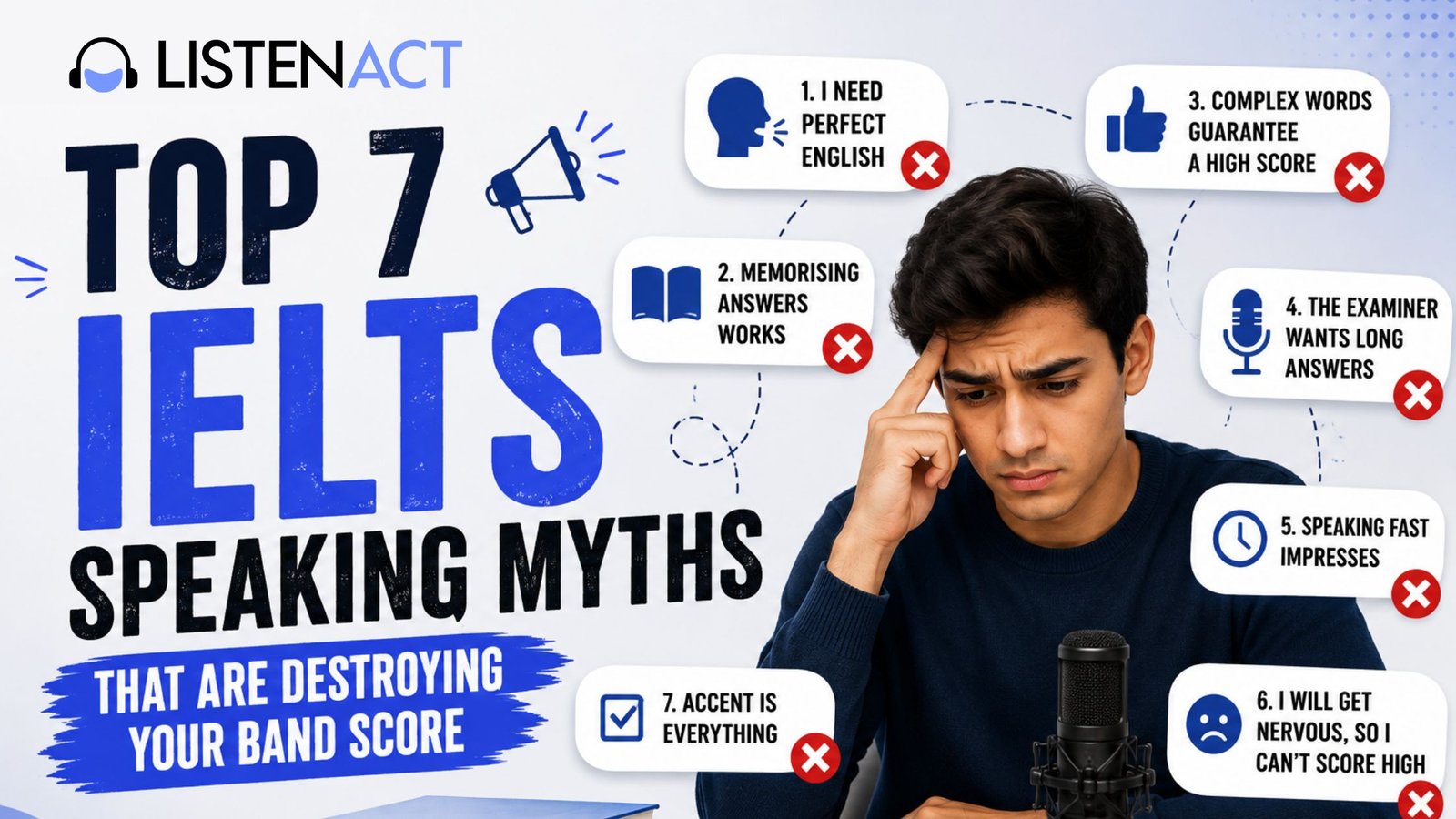
When it comes to the IELTS speaking test, most students don’t fail because they lack effort. They fail because they follow the wrong advice.
Over time, so many myths have spread among students that they start believing things that actually reduce their score instead of improving it. If you are stuck at Band 5 or 6 even after practicing, there is a high chance that one of these myths is silently holding you back.
Let’s break them one by one.
Myth 1: You Need Perfect Grammar to Get a High Band
This is probably the most common belief. Students spend months trying to fix every grammatical mistake before they feel confident enough to speak.
In reality, the speaking test does not require perfect grammar. Examiners are looking for fluency, clarity, and the ability to express ideas. Small mistakes are completely acceptable.
In fact, many students with slightly imperfect grammar score higher than those who speak slowly while trying to be perfect. Fluency always creates a stronger impression than hesitation.
Myth 2: Memorizing Answers Will Help You Score More
Many students prepare fixed answers for common topics like hobbies, hometown, or favorite food. It gives a sense of control and confidence during practice.
However, the speaking test is designed to feel like a natural conversation. The moment your answer sounds memorized, your score can drop. Examiners are trained to detect unnatural patterns.
More importantly, memorization fails the moment the question changes slightly. Real speaking requires flexibility, not fixed scripts.
Myth 3: Speaking Fast Means Better Fluency
Some students try to speak quickly to appear fluent. They rush through sentences, thinking speed equals confidence.
But fluency is not about speed.. It is about smoothness and clarity. Speaking too fast can actually reduce your score if your pronunciation becomes unclear or your ideas are not properly expressed.
A natural pace, where your thoughts flow clearly, always works better than rushed speech.
Myth 4: Using Difficult Words Will Impress the Examiner
There is a strong belief that using advanced or “fancy” vocabulary automatically increases your band score.
The truth is, vocabulary should feel natural. If you use complex words incorrectly or force them into sentences, it creates confusion instead of impression.
Simple and correct language is always more powerful than complicated and incorrect expressions.
Myth 5: You Should Not Pause at All
Many students think that pausing is a sign of weakness. They try to avoid even a second of silence, which leads to fillers like “umm…”, “uhh…”, or broken sentences.
Pausing is actually normal in natural speech. Even native speakers pause to think. What matters is how you continue after the pause.
A short, natural pause is far better than continuous hesitation or unclear speech.
Myth 6: Only Studying Is Enough — Practice Is Optional
Students often spend hours reading tips, watching videos, and learning strategies, but very little time actually speaking.
Speaking is a performance skill. It improves only through repetition and real practice. Without regular speaking, your brain is not trained to respond instantly.
You may understand everything, but still struggle to express it during the test.
Myth 7: You Need Months or Years to Improve
This myth stops many students from even trying seriously. They believe improving speaking takes a very long time.
While consistency is important, the right method can speed up your progress significantly. When you focus on real speaking, thinking in English, and practicing daily, improvement can happen much faster than expected.
It is not about time — it is about method.
The Reality Most Students Ignore
The IELTS speaking test is not about being perfect. It is about being natural. Students who treat it like a memorization exam struggle. Students who treat it like a real conversation improve faster.
Once you stop following myths and start focusing on actual communication, your confidence and band score both begin to rise.
If you are stuck at the same band score, don’t just practice more… practice smarter.
Identify which of these myths you believed, correct your approach, and start training your speaking like a real skill instead of a theory subject.
That one shift can completely change your result.
