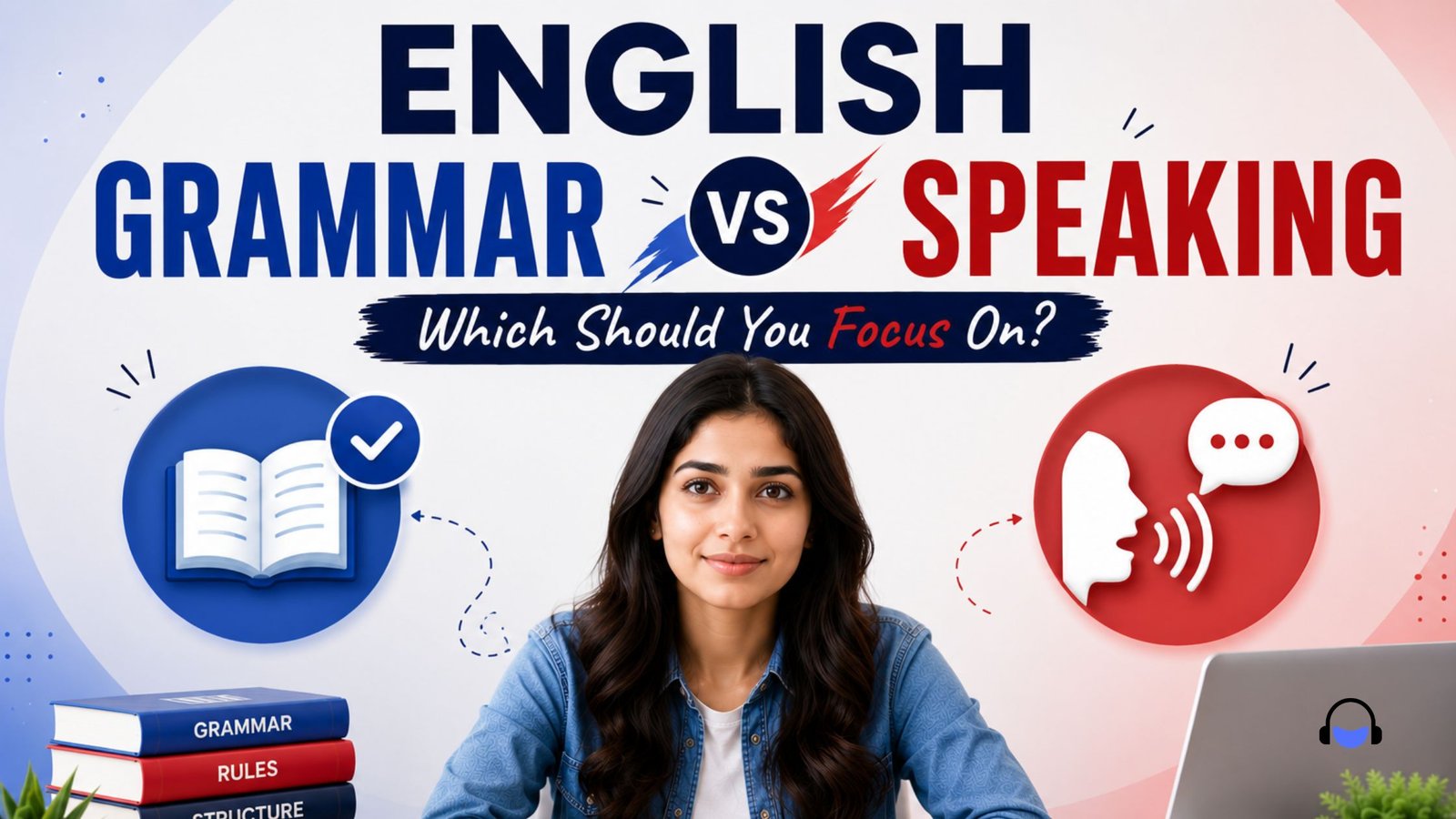
One of the most common questions English learners ask is:
“Should I improve my grammar first or start speaking English?”
Some people believe you must master grammar before opening your mouth. Others say grammar doesn’t matter at all and that you should simply start speaking. The truth lies somewhere in between.
Grammar and speaking are both important, but they play different roles in your English journey. Focusing too much on one while completely ignoring the other can slow your progress. Understanding when to prioritize grammar and when to prioritize speaking can help you become a more confident English speaker much faster.
Why Most Learners Spend Too Much Time on Grammar
In many schools, English is taught as a subject rather than as a language. Students spend years learning tenses, articles, prepositions, active and passive voice, reported speech, and countless grammar rules. They complete exercises, memorize definitions, and score well in exams.
However, after leaving school, many of those same students struggle to introduce themselves confidently in English or have a simple conversation. This happens because grammar teaches you how the language works, but it doesn’t automatically teach you how to use it.
Knowing every traffic rule doesn’t make someone a good driver. In the same way, knowing grammar doesn’t automatically make someone a confident speaker.
What Grammar Actually Does
Grammar provides structure to a language. It helps us build sentences that are clear and meaningful. Without grammar, communication can become confusing.
For example:
Yesterday I go market.
Most people will understand the meaning, but the sentence is grammatically incorrect.
A better sentence would be:
Yesterday I went to the market.
Good grammar makes your English more accurate and easier to understand. It becomes especially important in formal situations such as writing emails, taking IELTS or PTE, attending job interviews, or communicating professionally.
Grammar is not your enemy. The problem is making grammar your only focus.
What Speaking Actually Does
Speaking is the skill that allows you to communicate with other people. You may know hundreds of grammar rules, but if you hesitate every time someone asks you a question, those rules don’t help much in real conversations.
Speaking develops confidence, fluency, pronunciation, and the ability to express your ideas naturally. Like any other skill, speaking improves through practice rather than theory.
Nobody learns to swim by reading books alone. Similarly, nobody becomes fluent by studying grammar without actually speaking.
Can You Speak Good English Without Perfect Grammar?
Yes.
Think about young children. They speak their native language fluently long before they understand grammar terms such as nouns, verbs, or tenses. Many adults also communicate successfully in English even though they occasionally make grammatical mistakes.
Fluent communication does not require perfect grammar. It requires confidence, regular practice, and the ability to express your ideas clearly. Of course, improving grammar over time will make your English stronger, but waiting until your grammar is perfect before speaking is one of the biggest mistakes learners make.
When Should You Focus More on Grammar?
Grammar deserves more attention when your goal requires accuracy. For example, if you’re preparing for IELTS Writing, PTE Writing, academic assignments, business emails, or professional communication, grammar becomes increasingly important because mistakes can affect your score or the clarity of your message.
However, even in these situations, grammar should be practiced alongside speaking, listening, reading, and writing, not in isolation.
The Best Approach Is to Combine Both
The question should not be: Grammar or speaking?
The better question is: How can I balance both?
A practical study routine might look like this:
- Spend some time understanding grammar concepts.
- Learn complete sentences instead of isolated rules.
- Listen to natural English every day.
- Practice speaking regularly.
- Use the grammar you learn in real conversations.
This balanced approach helps grammar become part of your speaking instead of remaining something you only know from books.
Stop Waiting Until You're "Ready"
Many learners delay speaking because they think they need to finish grammar first. Unfortunately, that day never comes. English grammar is a vast subject, and there will always be another rule to learn.
If you wait until you know every grammar rule, you may never begin speaking confidently. Instead, start speaking with the grammar you already know. Make mistakes. Learn from them. Improve gradually. That is how real progress happens.
Final Thoughts
Grammar and speaking are not competitors. They are partners. Grammar gives your English structure, while speaking gives it life. If your goal is to become a confident English speaker, don’t spend years studying grammar without using it. At the same time, don’t ignore grammar completely because it helps you communicate more accurately.
The most effective learners study a little grammar, practice a lot of speaking, and gradually improve both together. Remember, people don’t learn a language to pass grammar tests. They learn a language to communicate.
Frequently Asked Questions
Should I learn grammar before speaking English?
No. You can start speaking English from the very beginning while learning grammar gradually. Waiting until you have perfect grammar often delays progress and reduces confidence. Speaking and grammar should develop together rather than one after the other.
Can I become fluent without learning grammar?
You can become a confident communicator with basic grammar, but completely ignoring grammar is not a good idea. Grammar helps you express your ideas more accurately and becomes increasingly important in professional communication, writing, and English proficiency exams.
How much grammar do I need to speak English?
You don’t need to master every grammar rule before speaking. A basic understanding of common tenses, sentence structure, and everyday grammar is enough to start communicating. As your speaking improves, your grammar can improve naturally through practice and feedback.
Why do I know grammar but still can't speak English?
This is a common problem because grammar is knowledge, while speaking is a skill. Skills improve through regular practice. If you spend all your time reading grammar books but rarely speak English, you may understand the rules without being able to use them confidently.
What is the fastest way to improve both grammar and speaking?
The best approach is to combine both. Learn grammar in small amounts, study complete sentence patterns, listen to natural English, and practice speaking every day. Using grammar in real conversations helps you remember it much better than memorizing rules alone.
