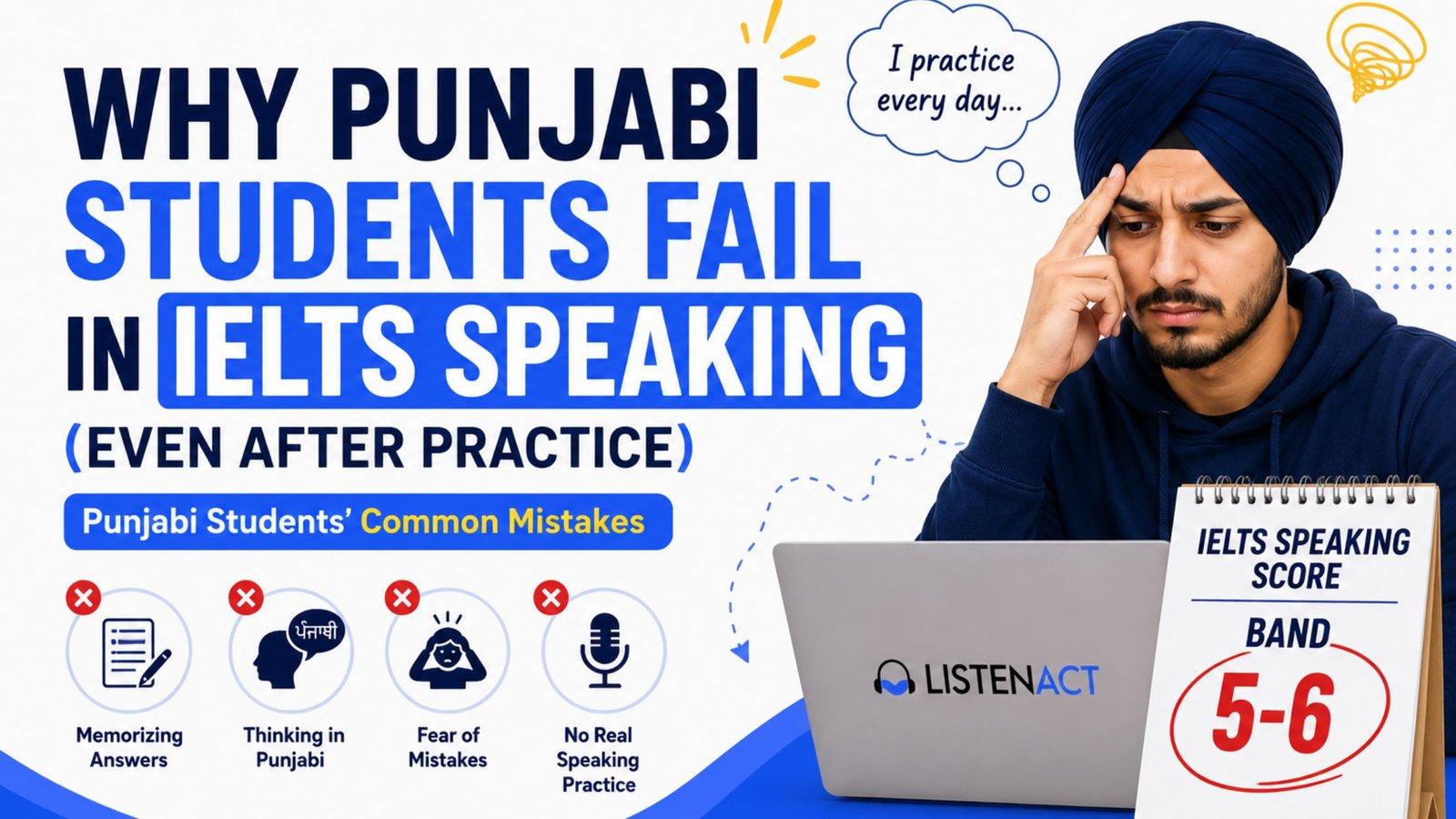
Every year, thousands of students prepare for the IELTS exam with full dedication. They attend coaching classes, watch hours of YouTube videos, and practice speaking whenever they get time. Still, when the final result comes, many Punjabi students find themselves stuck at Band 5 or 6 in the speaking section.
This creates confusion and frustration. “I practiced so much… then why didn’t I improve?”
The truth is uncomfortable but important: most students are not failing because they lack English knowledge. They are failing because they are practicing in a way that does not match how real speaking works.
The Hidden Problem: Thinking in Punjabi, Speaking in English
One of the biggest challenges Punjabi students face is not vocabulary or grammar.. it is the habit of thinking in their native language first.
When the examiner asks a simple question, the brain goes through a long process: understanding in English, translating into Punjabi, forming the answer, and then translating back into English before speaking. This delay breaks fluency and creates hesitation.
Instead of sounding natural, the speech becomes slow, filled with pauses, and sometimes incomplete. This is exactly what examiners notice. The issue is not your English level.. it is the thinking process behind it.
Practice Is Happening… But Not the Right Kind
Many students genuinely believe they are practicing enough. However, most of that “practice” is passive. Watching videos, reading sample answers, or memorizing scripts feels productive, but it does not train your speaking ability.
Speaking is a skill that improves only when you actually speak out loud, regularly, and under real conditions.
Think about it like this: you cannot learn swimming by watching tutorials. You have to get into the water. Similarly, you cannot improve your speaking band without putting your brain in real-time speaking situations.
Memorization Feels Safe But It Backfires
Another common pattern is memorizing answers. Students prepare fixed responses for common questions like hobbies, hometown, or daily routine. This gives confidence during practice, but it creates a serious problem in the exam.
The moment the examiner asks something unexpected, the memorized structure collapses. The student struggles, pauses, or gives unnatural answers. Even worse, examiners are trained to detect memorized content, which can reduce your score.
Real fluency does not come from remembering sentences… it comes from being able to form them instantly.
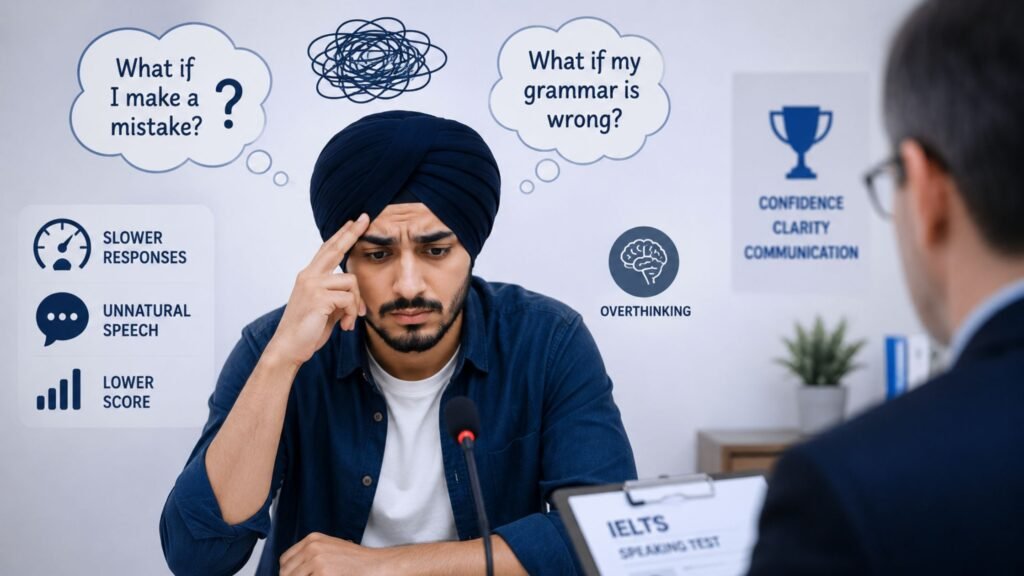
Fear Silently Reduces Your Score
Even students who know English well often underperform because of fear. During the speaking test, thoughts like “What if I make a mistake?” or “What if my grammar is wrong?” start controlling the mind.
This leads to overthinking, slower responses, and unnatural speech. Ironically, trying to be perfect ends up making the performance worse.
In reality, examiners are not looking for perfect grammar in every sentence. They are looking for confidence, clarity, and the ability to communicate ideas smoothly.
Grammar Is Important But Fluency Matters More
Many Punjabi students focus heavily on grammar rules, believing that perfect grammar guarantees a high band score. While grammar does matter, it is only one part of the evaluation.
Fluency, coherence, pronunciation, and natural expression carry equal if not more weight. A student who speaks confidently with small mistakes often scores higher than someone who speaks slowly with perfect grammar.
The goal is not to sound like a textbook. The goal is to sound like a real speaker.
So, What Actually Works?
Improving your IELTS speaking score requires a shift in approach rather than just more effort.
Start by training your brain to think directly in English. This can begin with simple daily activities describing what you are doing, forming small sentences in your mind, or talking to yourself in English. Over time, this reduces the need for translation.
At the same time, increase your actual speaking practice. Not just five or ten minutes, but consistent, focused speaking sessions where you answer questions, express opinions, and speak without preparation.
One of the most effective methods is audio-based learning. Listening to natural English and repeating it helps your brain absorb sentence structure, pronunciation, and flow automatically. This method builds speaking ability in a way that feels natural rather than forced.

The Real Shift You Need to Make
Most students prepare for IELTS like it is a written exam. They read, memorize, and study rules. But speaking is not about studying – it is about training.
The moment you shift from “learning English” to “using English,” everything starts to change. Your confidence improves, your hesitation reduces, and your responses become more natural.
Punjabi students are not weak in English. In fact, many understand the language quite well. The real issue lies in how they practice and how they approach speaking.
Once you fix the method, improvement becomes much faster than expected.
If you focus on real speaking, stop relying on memorization, and train your brain to think in English, your band score will not stay stuck for long.
